There is one question that comes back every season as soon as a European customer tightens their sustainability specification: “do you have a recycled tray?”. The short answer is yes, and it is called rPET. The long one is this page, because the black rPET tray is not simply the green version of the usual one: it changes how the fruit looks on the shelf, it changes the role your packaging plays in the buyer's audit and, if you pick the wrong size, it changes your reject rate too.
At Fontanet Group we have spent 14 years supplying packaging to the agri-food sector from Fraga, in the heart of the Ebro valley stone fruit country, with a team that adds up to more than 30 years in the trade. We have watched PET arrive, watched it leave on price and watched it come back as rPET, pushed by Brussels. This page collects what packhouses ask before switching material.
What are black rPET trays?
A black rPET tray is a thermoformed tray with individual cavities, made from recycled PET —rPET, from recycled Polyethylene Terephthalate—and pigmented black. The starting material is not oil: it is PET bottles and containers that have been collected, washed, shredded and re-pelletised until they are raw material fit for thermoforming again.
It is the same plastic as a water bottle, with the same moisture resistance and the same dimensional stability, but entering its second life instead of its first. And when it is done it goes back into the recycling stream, so the loop can close again.

The black colour is not an aesthetic whim
It is the first thing that surprises anyone coming from a grey or white tray, and it does three concrete things:
- It lifts the colour of the fruit by contrast. The red of a peach, the yellow of a flat peach or the green of an apple jump off a dark background in a way they simply do not off a pale one. On the shelf, that is attention time.
- It hides the traces of the journey. Dust, rub marks and condensation droplets show on a pale tray and disappear on a black one. The pack arrives looking the way it left.
- It moves the pack up a tier. Black reads as premium, which is why it is chosen by brands competing on positioning and not only on price.
Box formats and cavity sizes
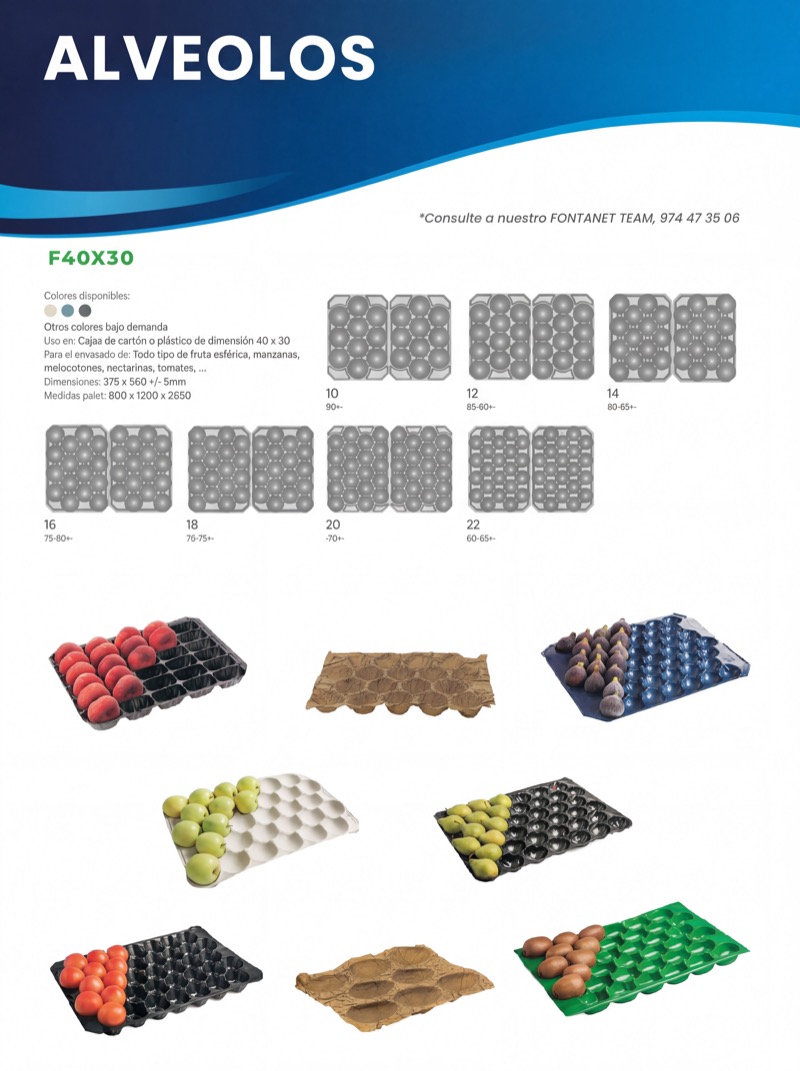
We work with the three box formats the sector uses —30x40, 30x50 and 40x60 cm— with different cavity counts and depths depending on the size of the piece. The geometry adapts to three fruit families:
- Round: apple, peach, orange, kiwi, persimmon, nectarine and tomato.
- Pear-shaped: Williams, Conference and Blanquilla pears, with a deeper cavity at one end.
- Flat: flat peach and flat nectarine, which need a wide, shallow cavity.
Seven advantages of the black rPET tray
- 100 % recyclable. It goes into the standard plastics stream and returns to production like any other PET pack. No special route, no dedicated waste handler.
- Made from plastic that has already been used. Every tonne of rPET that goes in is a tonne of petrochemical virgin PET that does not need to be produced.
- A smaller carbon footprint. The recycling industry estimates that producing rPET uses up to 75 % less energy than making virgin PET, because it starts from a material that is already polymerised.
- Better protection. Each piece sits in its own cavity, never touching its neighbour. That ends fruit-on-fruit rubbing, which is where a good share of stone fruit losses come from.
- Premium presentation. The black contrast makes the fruit look more alive at the point of sale, which is where the purchase is decided.
- Sturdy and reusable. It does not absorb moisture or soften in cold storage. It takes the weight, the condensation and the temperature swings without deforming, and it stands several uses if looked after.
- Compliant with European regulation. Approved for food contact under Regulation (EU) 10/2011 on plastic materials intended to come into contact with food.
Which fruit are they ideal for?
Black rPET works well across almost all medium-size fruit, but it really earns its place where rubbing is the problem: thin-skinned delicate fruit, which is the most heavily penalised on arrival.
- Round fruit: apple, peach, nectarine, orange, grapefruit, kiwi, persimmon and tomato.
- Pear-shaped fruit: Williams, Conference and Blanquilla pears.
- Flat fruit: flat peach and flat nectarine.
- Delicate fruit: plum, apricot and fig. This is where the individual cavity pays for itself.
| Fruit | Approximate size | Box format |
|---|---|---|
| Peach | 60-80 mm | 40x60 · 30x50 |
| Flat peach | 55-75 mm | 40x30 · 30x50 |
| Apple | 65-85 mm | 40x60 |
| Pear | 60-80 mm | 40x60 |
| Nectarine | 55-75 mm | 40x30 · 40x60 |
| Plum | 40-55 mm | 40x30 |
| Kiwi | 45-65 mm | 40x30 · 30x50 |
| Persimmon | 60-80 mm | 40x60 |
| Tomato | 50-70 mm | 40x30 · 30x50 |
Sizes are indicative: they vary between harvests and between varieties. Before closing an order it is worth measuring a sample from the current season, and that is what the physical sample is for.
Black rPET against the other options
No material wins at everything. This is the honest comparison against the three alternatives we are asked to quote alongside rPET:
| Feature | Black rPET | PP | Moulded pulp | Polystyrene |
|---|---|---|---|---|
| Recycled content | Yes | Not usually | Yes | No |
| 100 % recyclable | Yes | Yes | Yes, and compostable | Difficult |
| Moisture resistance | High | High | Low | Medium |
| Visual presentation | Premium, by contrast | Medium | Basic | Medium |
| Fruit protection | Excellent | Good | Medium | Good |
| Carbon footprint | Low | Medium | Low | High |
| Food contact approved | Yes | Yes | Yes | Yes |
| Reuse | Several times | Several times | Single use | Fragile |
If your buyer demands compostable packaging or you are exporting to a market with a plastic-free specification, moulded pulp is still the answer; we cover it in the complete guide to fruit trays. If what matters is presentation, moisture resistance and recycled content, black rPET wins.
Interested in this product? Request information or call 974 47 35 06.
Sustainability and the circular economy
The case for rPET is not that it is “good plastic”. It is that the plastic already exists, and what is being decided is whether it goes back into the loop or drops out of it. This is the full route:
-
Used bottle
A PET container ends its first life and goes into the recycling bin.
-
Collection and sorting
The sorting plant separates PET from the other plastics by type and by colour.
-
Washing and shredding
Labels, caps and residues are removed and the material is ground down into flakes.
-
rPET pellets
The flakes are decontaminated and re-pelletised into raw material approved for food contact.
-
Thermoformed tray
The pellets are extruded into sheet, pigmented black and thermoformed with the cavities of the chosen size.
-
And round again
When it has done its job the tray goes back into the recycling bin and re-enters the same loop.
The figure that usually closes the conversation: on the estimates the recycling industry works with, every tonne of rPET replacing virgin PET avoids in the order of 1.5 tonnes of CO₂. Over a season of any size, that is a concrete line in the sustainability report your customer asks you for.
What regulation is bringing
This is not a marketing fad: the European Green Deal and Directive (EU) 2019/904 on single-use plastics both push the same way —more recycled content inside the pack, and packs that can genuinely be recycled. Europe's large retail chains have published their own virgin-plastic reduction commitments, and that filters down into the specifications their suppliers sign.
In season terms: the recycled content of your packaging is about to stop being a selling point and become an entry requirement. Switching before you are told to costs less than switching with the order already closed.
Why choose Fontanet Group
We have spent 14 years working with packhouses, cooperatives and handling warehouses from Fraga, in Huesca, with people who add up to more than 30 years in the trade. Being inside the growing area is not a contact detail: it means we know the seasons from the inside and we deliver short to the region.
- Black rPET trays approved for food contact, supplied with the declaration of compliance.
- Permanent stock of the fastest-moving sizes of each season.
- A physical sample before the order closes, to check the size against your actual fruit.
- Real technical advice: we look at your fruit, your box and your line before recommending anything.
- Competitive pricing on volume, with delivery across Spain and the rest of Europe.
- After-sales service and continuous support throughout the season.
You can see the rest of our packaging solutions, the packaging machinery that goes with them, or read our story.
Frequently asked questions about black rPET trays
What does rPET mean?
Why are black trays better for presenting fruit?
Are black rPET trays safe for food contact?
Can rPET trays be reused?
What sizes of black rPET tray do you stock?
Are rPET trays more expensive than conventional plastic ones?
How do rPET trays differ from moulded pulp trays?
Can I order black rPET trays with my own brand or logo?
The complete guide to fruit trays
If you are still choosing a material, that guide compares moulded pulp, PP and rPET in detail, with the size tables for all three box formats and the selection criteria by type of fruit.
See the fruit tray guideYou may also be interested in
The punnet is the other level of the same pack. Our guide covers solid and corrugated board, moulded pulp, kraft, PET and PP, with the tray sealers and the line labeller.
See the punnet guideTraypack and Bussel for the apple season
The tray that protects apples piece by piece and the export carton that carries them, in detail: the cavity and calibre table for the 60x40 format, guidance by variety, how they fit into the packing line and delivery times.
See the traypack and bussel landing page
