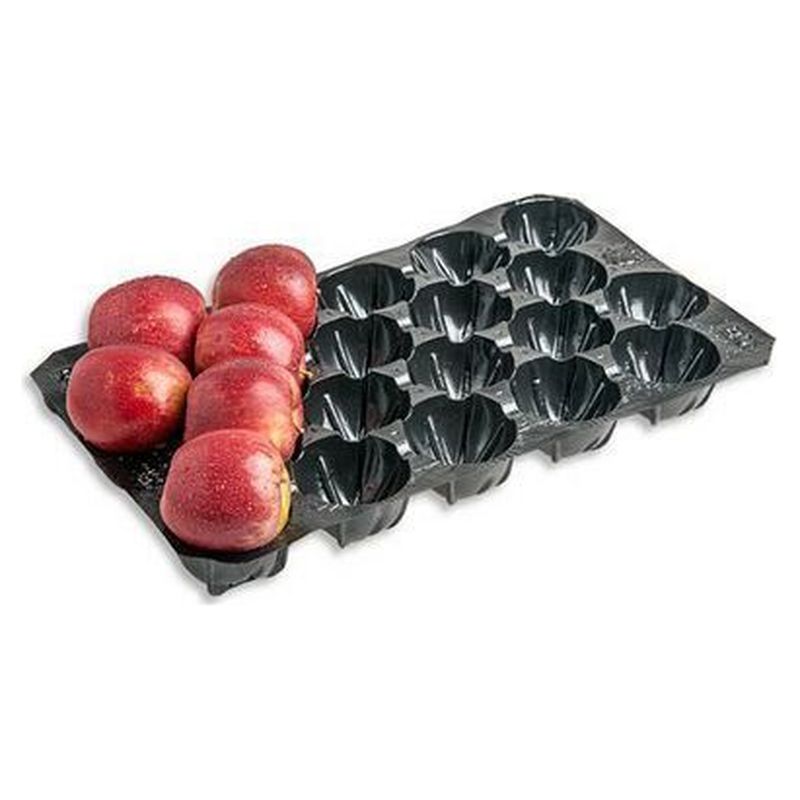
PP plastic fruit trays for round fruit
Thermoformed polypropylene trays with round cavities for apples, peaches, nectarines, tomatoes and all other round fruit.
A polypropylene (PP) fruit tray is a thermoformed tray with round cavities that separates and holds each piece of fruit inside the box. It is designed for round fruit such as apples, peaches, nectarines, plums and tomatoes, which move around the most when packed loose and bruise the most when they rub against the piece next to them. Each cavity keeps the fruit still and spreads transport knocks across the whole tray instead of concentrating them on one spot of the skin.
Compared with other materials, PP stands out for its toughness: it flexes without breaking, does not deform with the humidity of the cold store and withstands washing and disinfection. That is why it is the usual choice on high-volume lines and in returnable circuits, where the tray comes back to the packhouse and is reused. Its surface is non-absorbent, so juice from a very ripe piece rinses off and does not spread to the rest of the tray.
The cavity is chosen by calibre, which is the actual diameter of the fruit. If the hollow is too big, the piece rattles about and takes every knock; if it is too small, the fruit bruises as it is pressed in. As an indicative reference, peaches run between 60 and 80 mm, apples between 65 and 85 mm and tomatoes between 50 and 80 mm, with usual configurations of 20 to 30 cavities in a 60x40 box. Calibre changes from one season to the next, so it is worth measuring the current crop before placing the order.
Polypropylene comes in many colours (clear, white, black, blue, red, yellow or green), which lets you tell grades or brands apart within the same packhouse. At the end of its useful life it goes into the yellow recycling bin, with resin code 5.
At Fontanet Group we work from Fraga (Huesca), right in the growing area, with a team that has more than 30 years of experience in the fruit and vegetable sector. We help you choose the calibre and format, and we send you a physical sample so you can test it with your own fruit. Our sales team will confirm the thickness, weight and number of cavities of each reference.
Advantages
- Moisture-resistant. It does not soften in cold storage or with condensation: the tray keeps its shape for the whole journey.
- Reusable and washable. It withstands washing and disinfection cycles, so it fits returnable circuits.
- Piece-by-piece protection. Each fruit sits in its own cavity and does not rub against its neighbours, which is where much of the waste begins.
- Easy to clean. The surface does not absorb juice from the ripest pieces: a quick rinse is enough.
- Choice of colours. Clear, white, black and other colours to tell grades or brands apart in the packhouse.
Specifications
| Feature | Detail |
|---|---|
| Material | Thermoformed polypropylene (PP) |
| Usual box formats | 60x40 and 50x30 cm |
| Indicative calibres | Peach 60-80 mm · Apple 65-85 mm · Tomato 50-80 mm |
| Usual cavities in 60x40 | From 20 to 30, depending on calibre |
| Usual thicknesses | From 0.3 to 0.6 mm |
| Temperature resistance | From −10 °C to +120 °C |
| Colours | Clear, white, black, blue, red, yellow and green |
| Recycling | Yellow recycling bin, code 5 |
Usual values for the material and indicative figures by fruit. The thickness, weight and cavities of each reference are confirmed by the sales team.
Which sectors is it for?
- Fruit and vegetable packhouses
- Agricultural cooperatives
- Handling plants
- Fruit export
- Food distribution
Interested?
Call us on 974 47 35 06 or message us on WhatsApp at 649 943 962.
Frequently asked questions
Which tray calibre do I need for my fruit?
The one that matches the actual diameter of your fruit. As a guide: peach 60-80 mm, apple 65-85 mm, nectarine 55-75 mm and tomato 50-80 mm. Measure a sample from the current season, or send it to us, and we will tell you which reference suits you.
Can PP fruit trays be reused?
Yes. Polypropylene withstands washing and disinfection and does not deform with humidity, so it can be used several times if handled and stored properly. That is why it is common in returnable circuits.
How does it differ from a moulded pulp tray?
Moulded pulp is compostable and absorbs surface moisture, and it is the one usually requested for export under plastic-free specifications. PP stands up better to humidity and repeated use. If you are torn between the two, we will advise you based on your fruit and your customer.
Related products
![]() EMBALAJES FONTANETView details
EMBALAJES FONTANETView detailsPear-shaped PP plastic trays for pears
A cavity that is deeper on one side to hold the neck of Conference, Blanquilla or Williams pears.
![]() EMBALAJES FONTANETView details
EMBALAJES FONTANETView detailsPP plastic trays for flat peaches
A wide, shallow cavity for flat peaches and flat nectarines, in moisture-resistant polypropylene.
![]() EMBALAJES FONTANETView details
EMBALAJES FONTANETView detailsClear rPET fruit trays
Recycled PET with full transparency so premium fruit is seen whole on the shelf.
![]() EMBALAJES FONTANETView details
EMBALAJES FONTANETView detailsMoulded pulp fruit trays for export
Compostable moulded pulp with FSC available, in F60X40 and F40X30 formats for plastic-free export.


Need more information?
We advise you with no obligation and help you choose the right option for your process.
