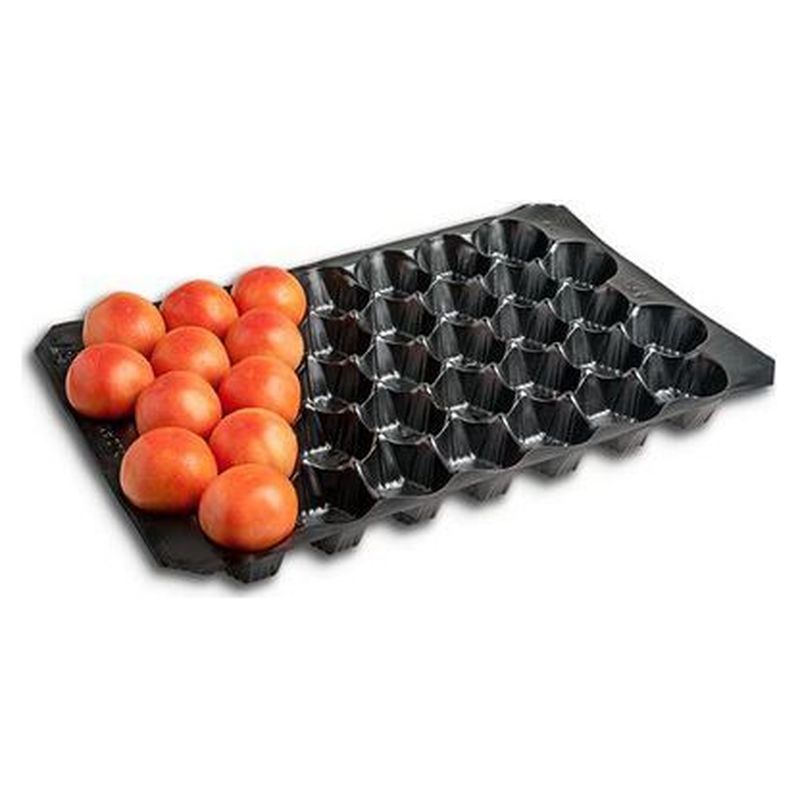
Plastic trays for tomatoes
Trays with individual cavities and ventilation channels for a product that keeps ripening inside the box.
Tomatoes are a special case among products packed in trays, because they keep actively ripening inside the box and give off ethylene. They need protection from knocks and rubbing, but above all they need air to circulate. A tray that is too enclosed speeds up the ripening of the whole tray and shortens shelf life just when it matters most, on the final stretch to the point of sale.
That is why for tomatoes we look for designs with generous ventilation channels between cavities. Each piece is held in its hollow without touching the one next to it, and air can move through the closed box, which reduces condensation and the spots where rot starts at the base of the fruit.
In plastic there are two options. Polypropylene (PP) resists moisture, does not deform and can be washed and reused, and it is also the usual material for other premium shelf vegetables, such as peppers. rPET, or recycled PET, gives stiffness at low thickness and a more polished presentation, in clear or black, and it is the option when the specification calls for recycled material.
As an indicative reference, tomatoes run in calibres from 50 to 80 mm depending on the variety (salad, plum or vine), with usual configurations of 20 to 30 cavities in a 60x40 box. In the 40x30 and 30x50 formats, rPET is used with calibres from 50 to 70 mm. What counts is the actual calibre of your production, which is worth measuring on the current season.
From Fraga (Huesca), with a team that has more than 30 years in the sector, we advise you on material, format and calibre, and we send you a physical sample to test with your tomatoes before you order. The available references, with their thickness and number of cavities, are confirmed by our sales team.
Advantages
- Generous ventilation. Air circulates between cavities and slows the accelerated ripening of the tray.
- Piece by piece. Each tomato in its own hollow, with no rubbing against its neighbours.
- Less condensation. Air circulation reduces moisture at the base of the piece.
- PP or rPET. Strength and reuse, or recycled material with better presentation.
- For several varieties. Salad, plum or vine tomatoes, depending on calibre.
Specifications
| Feature | Detail |
|---|---|
| Material | Polypropylene (PP) or recycled PET (rPET) |
| Design | Individual cavity with ventilation channels |
| Varieties | Salad, plum, vine |
| Indicative calibre | 50-80 mm depending on variety |
| Usual cavities in 60x40 | From 20 to 30 |
| Other formats | 40x30 and 30x50 (rPET, calibres from 50 to 70 mm) |
| Colours | Depending on material: clear, black and others |
| Recycling | Yellow recycling bin |
Indicative calibres and cavities. For available references, thickness and colour, ask the sales team.
Which sectors is it for?
- Tomato growers
- Fruit and vegetable packhouses
- Retail and supermarkets
- Premium vegetables
Interested?
Call us on 974 47 35 06 or message us on WhatsApp at 649 943 962.
Frequently asked questions
Why do tomatoes need a ventilated tray?
Because they keep ripening in the box and give off ethylene. Without air circulation, ripening speeds up across the whole tray and condensation forms. Ventilation channels between cavities prevent this.
Which tomato calibre does it take?
As a guide, from 50 to 80 mm depending on the variety, with 20 to 30 cavities in a 60x40 box. Send us a sample of your production and we will tell you the reference.
PP or rPET for tomatoes?
PP resists moisture and can be reused; rPET is recycled material and offers a more polished presentation. We will advise you based on your sales channel and your customer.
Related products
![]() EMBALAJES FONTANETView details
EMBALAJES FONTANETView detailsPP plastic fruit trays for round fruit
Polypropylene trays with round cavities for apples, peaches, nectarines and tomatoes.
![]() EMBALAJES FONTANETView details
EMBALAJES FONTANETView detailsClear rPET fruit trays
Recycled PET with full transparency so premium fruit is seen whole on the shelf.
![]() EMBALAJES FONTANETView details
EMBALAJES FONTANETView detailsMoulded pulp fruit trays for export
Compostable moulded pulp with FSC available, in F60X40 and F40X30 formats for plastic-free export.
![]() EMBALAJES FONTANETView details
EMBALAJES FONTANETView detailsPlastic fruit trays for kiwi
An oval cavity so kiwis lie on their side, in PP or rPET.


Need more information?
We advise you with no obligation and help you choose the right option for your process.
